If the universe is expanding, what is it expanding into?
Discover why this question starts from a wrong premise: the universe isn't expanding 'into' anything. Space itself is growing, and mathematics works where our intuition fails.
The question starts from a wrong premise
If the universe is expanding, what is it expanding into?
Short answer: into nothing.
The universe isn’t expanding “into” something larger. There’s no “empty space” around the universe it’s “entering.”
Space itself is growing.
It’s not matter spreading through space — it’s the space between things that’s increasing.
And when I first understood this, I realized how our intuition about the universe is completely broken by the experience of living in 3 dimensions.

The intuition error: imagining the universe as a “box”
We grow up imagining that everything needs to be inside something larger.
- The ball is inside the box
- The box is inside the room
- The room is inside the house
- The house is inside the city
- Earth is inside the solar system
- The solar system is inside the galaxy
- The galaxy is inside…?
And then the brain completes: “the universe is inside… something?”
No.
The universe isn’t an object inside a space. The universe is space.
Asking “what is the universe expanding into?” is like asking “what’s north of the North Pole?” — the question doesn’t make sense because it starts from a wrong premise.
The balloon analogy (that finally made me understand)
This is the classic analogy used by cosmologists — and it works very well if you understand what it represents.
Imagine the surface of a balloon being inflated.
- Draw dots (galaxies) on the surface
- Inflate the balloon
- All dots move away from each other
Question: What is the balloon’s surface expanding into?
Answer: Into nowhere “within the surface.” The surface itself is growing.
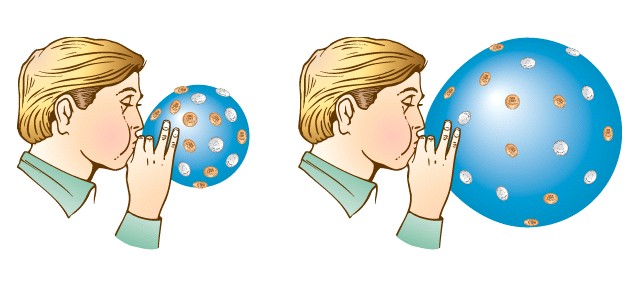
The key point:
- The “balloon’s surface” = our 3D space
- The “inside of the balloon” = an extra dimension we don’t access
- An ant living on the surface doesn’t see the 3rd dimension (up/down from balloon)
- We living in 3D space don’t see the 4th spatial dimension (if it exists)
From the ant’s perspective:
- There’s no “inside” or “outside”
- Only the surface exists
- And the surface is growing without growing “into” anything
From our perspective:
- There’s no “outside the universe”
- Only 3D space exists
- And space is growing without growing “into” anything
Metric expansion: space itself is growing
In cosmology, this is called metric expansion of space.
Metric = measure of distance between points in space.
The metric describing the universe is called the FLRW metric (Friedmann-Lemaître-Robertson-Walker). It includes a scale factor that changes with time:
a(t) = scale factor as a function of timeWhen a(t) increases, distances in the universe increase proportionally.
Visual example:
Imagine two galaxies separated by 1 million light-years.
- At time
t₁: distance = 1 million light-years - At time
t₂: distance = 2 million light-years
Question: Did the galaxies move?
Answer: No. The space between them grew.
It’s like raisins in rising bread — the raisins don’t “move” through the bread, the bread grows and the raisins naturally drift apart.
”But it has to expand into somewhere!”
This is the stubborn intuition everyone has.
It seems obvious that if something grows, it must be growing inside something larger.
But it only seems obvious because we live in 3 spatial dimensions.
Dimensional analogy:
1D world (line):
- A 1D being lives on a line
- For them, only “left” and “right” exist
- Can’t conceive “up” and “down”
2D world (plane):
- A 2D being lives on a plane (like paper)
- For them, “forward/backward” and “left/right” exist
- Can’t conceive “up” (3rd dimension)
3D world (ours):
- We live in 3 spatial dimensions
- For us, “height,” “width,” and “depth” exist
- We can’t conceive a 4th spatial dimension
If the universe has a “curved” 4th spatial dimension, expansion happens in that dimension — which we simply can’t visualize.
But mathematically? Works perfectly.
Finite vs infinite universe: both can expand
Here it gets even stranger.
If the universe is finite (but without edge):
Think of a sphere’s surface (like Earth).
- Has finite area
- But no edge
- If you walk in a straight line, you return to the starting point
The universe could be like this — finite in size, but without “edge” or “end.”
If so, it expands by curving into a 4th dimension we don’t see.
If the universe is infinite:
Here everything breaks.
If the universe is already infinite, it remains infinite while expanding.
“But how can infinity get bigger?”
Mathematically: Distance between points increases, but there continue to be infinite points.
Analogy: Even numbers (2, 4, 6, 8…) are infinite. Natural numbers (1, 2, 3, 4…) are also infinite. But there are “more” natural numbers than even numbers — both infinite, but with different “sizes” (technically, cardinalities).
An infinite universe would work similarly — infinity that “grows” without ceasing to be infinite.
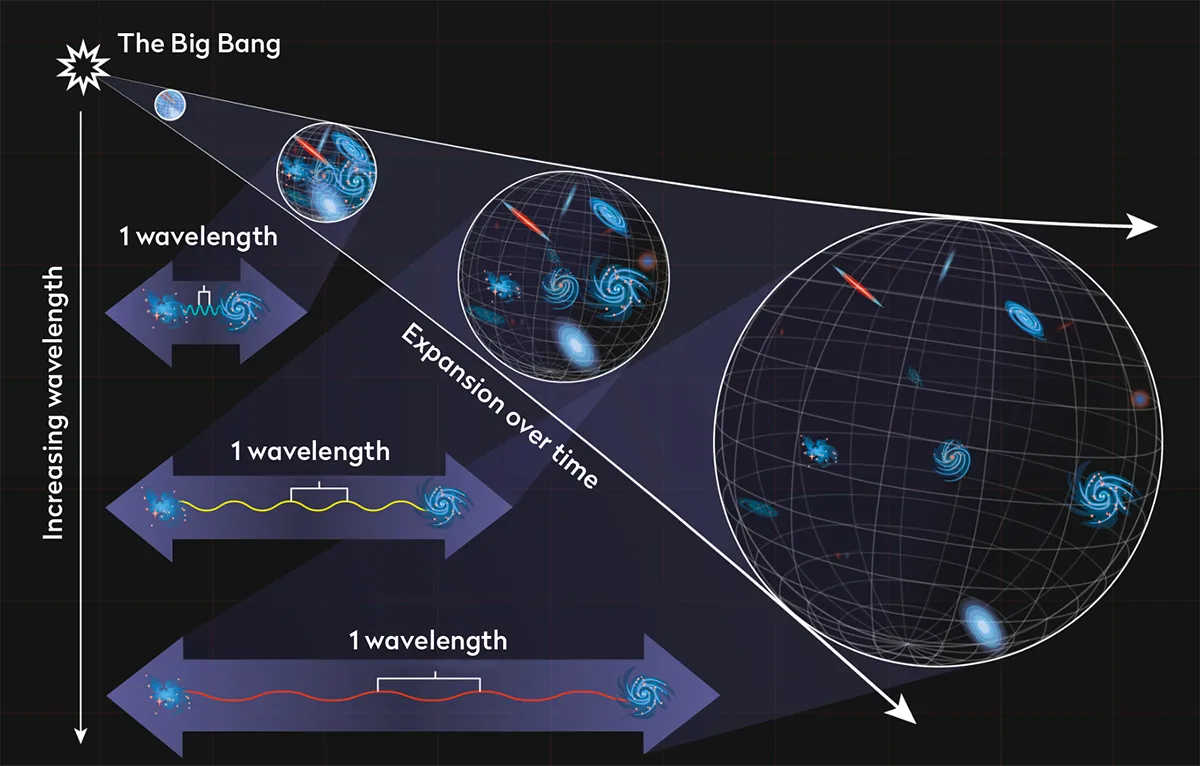
Galaxies aren’t “moving” — space is growing
This is crucial to understand properly.
When we see distant galaxies moving away from us, the temptation is to think:
“They’re traveling through space, moving away.”
Wrong.
They’re not moving (or move very little due to peculiar velocities). The space between us and them is growing.
That’s why very distant galaxies can “move away” from us at speeds faster than light — they’re not violating relativity, because it’s not motion through space.
Relativity says: “nothing moves through space faster than light.”
It says nothing about space itself growing.
Questions I had (and the answers)
“If it doesn’t expand into anywhere, how can it be growing?”
Because “growing” doesn’t mean “occupying new space.” It means “the space metric increases.” Distances between points get larger — without the points moving.
“Does the universe have an edge?”
We don’t know. If it’s finite, it probably has no edge (like a sphere’s surface). If it’s infinite, it definitely doesn’t.
“Can you ‘leave’ the universe?”
No. There’s no “outside” the universe. It’s like asking “can you leave time?” — the question doesn’t make sense.
“If the universe is infinite, how did it start at a point (Big Bang)?”
The Big Bang wasn’t an explosion at a point in space. It was the beginning of space-time itself. If the universe is infinite today, it was already infinite at the Big Bang — just infinitely dense.
“So is there a 4th spatial dimension?”
Maybe. Mathematically it works with or without. If there is, we can’t access it directly — only infer it from space curvature.
Why mathematics works and intuition fails
Because our brain evolved to survive in the African savanna, not to understand cosmology.
Intuition works for:
- Human-sized objects
- Everyday speeds
- Terrestrial scales
Intuition breaks for:
- Speeds close to light (relativity)
- Subatomic scales (quantum)
- Cosmological scales (universe expansion)
And that’s okay. Mathematics compensates.
The FLRW metric perfectly describes universe expansion — even if our intuition screams “but this doesn’t make sense!”
It’s like quantum mechanics: particles are in two places at once, cats are alive and dead simultaneously, observing changes the result.
None of this makes intuitive sense. But the math works.
What really happens when the universe expands
Let me try to summarize everything simply:
- The Big Bang wasn’t an explosion at a point in empty space
- It was the beginning of space-time itself
- Since then, space has been growing
- Galaxies drift apart because the space between them increases
- There’s no “outside” the universe for it to expand into
- Expansion happens everywhere, at the same time
- The more distant the galaxy, the faster it appears to recede (Hubble’s Law)
Result: The universe doesn’t expand “into” anything. It just… expands. The very concept of “space” is growing.
Why this fascinates me (and frustrates me)
Because it shows the limits of human intuition.
I can understand the mathematics. I can do the calculations. I can even correctly predict results.
But I can’t visualize it.
My brain simply doesn’t have the hardware to “see” 4 spatial dimensions or “feel” what it means for space to grow without growing into something.
And this isn’t my failure — it’s a limitation of being human living in 3D.
But the mathematics works.
And that’s beautiful. It shows we can understand things we can’t visualize.
We can describe the universe with absurd precision — even without being able to “see” how it really is.
Mathematics works where intuition fails. And that’s okay.
💡 Summary in 3 points:
- The universe doesn’t expand “into” anything — space itself is growing (metric expansion)
- The balloon analogy works: the surface grows without growing “into” anything within the surface
- Our intuition fails because it evolved for 3 dimensions, but mathematics (FLRW metric) works perfectly
Enjoyed understanding cosmology by breaking intuitions? I wrote another post about the universe along the same lines. Check out What is the center of the universe? — it’s about why everywhere is the center (and nowhere is).
References:
-
NASA WMAP: Expansion of the Universe map.gsfc.nasa.gov
-
NASA JPL: Exploring the Mystery of Our Expanding Universe jpl.nasa.gov
-
Wikipedia: Metric expansion of space en.wikipedia.org
-
Math UCR: Do Atoms Get Bigger as the Universe Expands? math.ucr.edu
Personal note: I want to study more about “Hubble Tension” — different methods of measuring the expansion rate give different results (~67 vs ~73 km/s/Mpc). Either there’s measurement error, or there’s new physics we don’t understand. Fascinating and scary. That’s for another post.